What to eat after a workout: high-protein meals from what’s in your fridge
Eat a normal meal with about 20–40 g of protein within a couple of hours of training, and make sure the whole day adds up: the International Society of Sports Nutrition (ISSN) suggests women who train aim for the middle to upper part of 1.4–2.2 g of protein per kilogram of body weight. The strict 30-minute “anabolic window” doesn’t hold up once total protein is equal, so eggs, Greek yogurt, cottage cheese, canned fish, leftover chicken, tofu or lentils are all you need.
SOMA Team · · 5 min read
( In short )
- Daily total comes first: the ISSN suggests women who train aim for the mid-to-upper part of 1.4–2.2 g/kg a day.
- Per meal, about 20–40 g of protein (0.25–0.40 g/kg), spaced every three to four hours.
- After training, a protein-rich meal within roughly two hours is plenty; there is no 30-minute deadline.
- The five fridge formulas below each land at roughly 31–44 g of protein and 400–475 kcal.
How much protein do you need after a workout?
Think in two numbers: the dose per meal and the total per day.
Per meal. The ISSN’s position stand on nutrient timing says a 20–40 g dose of high-quality protein (0.25–0.40 g per kilogram of body weight) every three to four hours appears to most favorably affect muscle protein synthesis (Kerksick et al., 2017). Its protein position stand adds that each dose should contain 700–3,000 mg of leucine, an essential amino acid closely tied to muscle protein synthesis (Jäger et al., 2017).
The ISSN’s 2023 position stand on female athletes is more specific. Based on the limited research in women, it recommends 0.32–0.38 g/kg of high-quality protein as close to the start and/or end of exercise as possible, toward the upper end in the luteal phase of the cycle (Sims et al., 2023). For a 65 kg woman, that is about 21–25 g.
Per day. The ISSN puts most exercising people at 1.4–2.0 g/kg a day, noting that 2.3–3.1 g/kg may be needed to hold on to lean mass while in a calorie deficit (Jäger et al., 2017). For women, it recommends the mid-to-upper part of 1.4–2.2 g/kg a day, with doses spread every three to four hours (Sims et al., 2023). A meta-analysis of 49 trials with 1,863 participants found no further gains in fat-free mass from protein beyond about 1.6 g/kg a day (Morton et al., 2018).
Do you really need to eat within 30 minutes of training?
No. The idea of a narrow post-workout “anabolic window” was tested in a 2013 meta-analysis. In studies that matched total protein between groups, timing appeared to matter little as long as enough protein was eaten, and the authors concluded that current evidence does not support the claim that eating protein within an hour of training significantly improves strength or muscle gains (Schoenfeld, Aragon & Krieger, 2013).
Timing isn’t irrelevant, though. Protein eaten from immediately to two hours after exercise stimulates a robust rise in muscle protein synthesis (Kerksick et al., 2017). If you trained fasted, or your last meal was more than three to four hours before training, eating at least 25 g of protein soon afterwards makes sense (Aragon & Schoenfeld, 2013). The ISSN’s guidance for women also leans toward eating close to training.
Do you need carbohydrate after a workout too?
Often, yes, and this is where timing has a stronger case. The ISSN’s timing stand says post-exercise carbohydrate timing matters most in two situations: when rapid restoration of muscle glycogen (the carbohydrate stored in muscle) is a primary goal, and when not enough carbohydrate is being eaten. Adding protein to carbohydrate can also speed glycogen recovery when the recovery window is short (Kerksick et al., 2017). In practice, if you train again the same day or tomorrow morning, put a real portion of carbohydrate on the plate. The female-athlete stand adds that women should first make sure they meet their carbohydrate needs across every phase of the menstrual cycle (Sims et al., 2023).
Do you need a protein shake?
Not if food is easier. The ISSN notes that active people can meet their protein needs from whole foods, recommends complete protein sources, and treats supplements as a safe, convenient option rather than a requirement (Jäger et al., 2017).
What are good high-protein meals from what’s already in your fridge?
Use a formula rather than a recipe: one protein anchor of 25–40 g, a carbohydrate if you trained hard or train again soon, vegetables, and a little fat for flavor. The numbers below are approximate, calculated from USDA FoodData Central entries and rounded (USDA). Brands and portions vary, so treat them as a starting point.
1. Greek yogurt, oats and berries
250 g plain nonfat Greek yogurt, 30 g rolled oats, 100 g raspberries and 15 g almonds. Stir the oats in and let it sit for five minutes, or make it the night before. About 400 kcal · 34 g protein · 44 g carbs · 11 g fat.

2. Eggs and cottage cheese on toast
Two large eggs scrambled with 100 g cottage cheese (2% fat) stirred in at the end, a handful of spinach (50 g) and a sliced tomato, on two slices of whole-wheat bread. About 415 kcal · 33 g protein · 39 g carbs · 14 g fat.
3. Tuna, black bean and rice bowl
110 g canned light tuna in water (drained), 100 g canned black beans, 100 g cooked rice, a chopped tomato and 2 teaspoons (10 g) of olive oil. About 420 kcal · 31 g protein · 49 g carbs · 12 g fat.
4. Leftover chicken and potato plate
120 g roast chicken breast, a 200 g potato baked in its skin, and 50 g of spinach wilted in 1 teaspoon (5 g) of olive oil. About 440 kcal · 44 g protein · 44 g carbs · 10 g fat.
5. Tofu, lentil and rice bowl
150 g firm tofu browned in a non-stick pan, with 100 g cooked lentils, 100 g cooked rice and 50 g spinach. About 475 kcal · 39 g protein · 54 g carbs · 14 g fat. Firm tofu varies widely: the USDA entry used here has about 17 g of protein per 100 g, and many supermarket blocks have less, so check the label. Each teaspoon of oil adds about 45 kcal.
How does SOMA size a recipe to what you have left today?
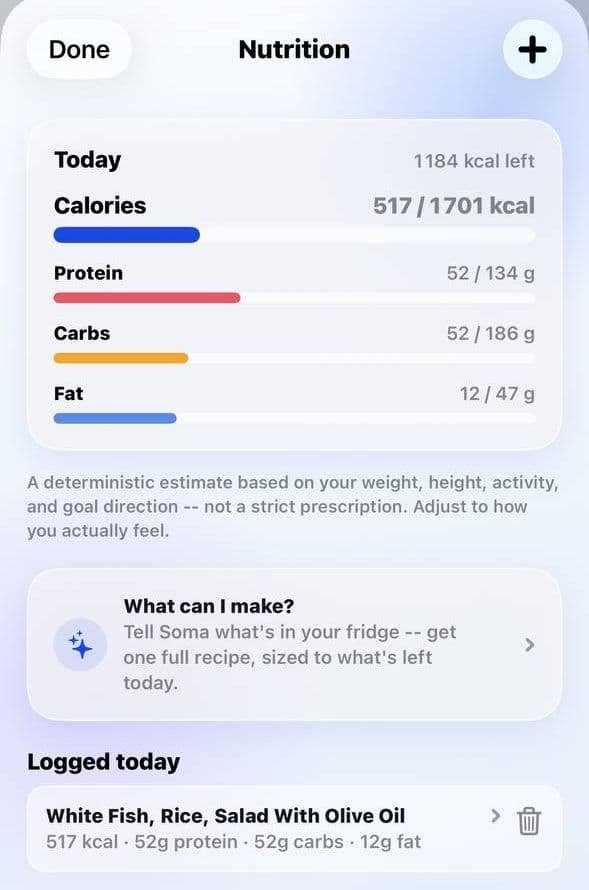
Most recipe apps start from a dish. SOMA starts from your fridge and your day. Tell it what you have, and it returns one full recipe sized to the calories and macros you have left today, shows how it fits before you commit, walks you through it step by step, then logs it.
The nutrition agent works alongside a fitness agent, and both read the data already on your iPhone from Apple Health, Apple Watch, Oura and Whoop. The result is one plan for the day, with the session, the food and the reason behind each in the same place.
How do you adjust these meals for your own day?
- Lower calorie target: halve the carbohydrate and keep the protein anchor.
- Bigger training day: add rice, potato, oats or bread rather than doubling the protein.
- Plant-based: combine sources, such as tofu with lentils or edamame, to reach the same dose.
- Easy or rest day: keep the protein. The daily total counts on recovery days too.
On mornings when recovery is low, see Low HRV: should you work out today?. If you are training somewhere unfamiliar, here is how to build a workout with only the equipment you have.
Questions people ask
How much protein should I eat after a workout?
About 20–40 g of high-quality protein, or 0.25–0.40 g per kilogram of body weight. The ISSN’s guidance for women suggests 0.32–0.38 g/kg close to training, which is roughly 21–25 g for a 65 kg woman.
Do I have to eat within 30 minutes of training?
No. A meta-analysis found that protein timing made little difference once total protein was matched. A protein-rich meal within about two hours is a sensible default, sooner if you trained fasted.
Is 1.6 g of protein per kg enough?
For many people, yes: a meta-analysis of 49 trials found no further fat-free mass gains above about 1.6 g/kg a day. The ISSN suggests women who train aim for the mid-to-upper part of 1.4–2.2 g/kg, and more may help preserve muscle while dieting.
Can I get enough protein without shakes?
Yes. Eggs, dairy, fish, meat, tofu and legumes can cover it. The ISSN treats protein powder as a convenient option, not a requirement.
How does SOMA know what to cook?
You tell it what is in your fridge. SOMA returns one recipe sized to the calories and macros you have left today, shows how it fits, walks you through it and logs it.
Sources
- International Society of Sports Nutrition Position Stand: protein and exercise (Jäger et al., 2017) — Journal of the International Society of Sports Nutrition
- International Society of Sports Nutrition position stand: nutrient timing (Kerksick et al., 2017) — Journal of the International Society of Sports Nutrition
- International Society of Sports Nutrition position stand: nutritional concerns of the female athlete (Sims et al., 2023) — Journal of the International Society of Sports Nutrition
- The effect of protein timing on muscle strength and hypertrophy: a meta-analysis (Schoenfeld, Aragon & Krieger, 2013) — Journal of the International Society of Sports Nutrition
- Nutrient timing revisited: is there a post-exercise anabolic window? (Aragon & Schoenfeld, 2013) — Journal of the International Society of Sports Nutrition
- A systematic review, meta-analysis and meta-regression of the effect of protein supplementation on resistance training-induced gains in muscle mass and strength in healthy adults (Morton et al., 2018) — British Journal of Sports Medicine
- FoodData Central (SR Legacy food composition data) — U.S. Department of Agriculture
General wellness information, not medical advice. If something feels off — persistent fatigue, illness, pregnancy, an injury — talk to a clinician before changing how you train or eat.
Keep reading

October 1, 2026 · 9 min read
SOMA vs Bevel: 7 differences that matter
SOMA vs Bevel on 7 points: wearables, daily training calls, workouts, nutrition, AI chat, cycle awareness and price, with where each app is the stronger pick.
October 1, 2026 · 10 min read
Best AI fitness coach apps for Apple Watch, Oura and Whoop owners (2026)
Seven AI fitness coach apps for Apple Watch, Oura and Whoop owners compared on data, daily guidance, workouts, nutrition, AI chat, cycle features and price.

October 1, 2026 · 10 min read
Apple Watch vs Oura vs Whoop for recovery-based training
Apple Watch, Oura Ring or Whoop for training by recovery? We compare HRV, sleep, workouts, battery, cost and phone support, and whether you need two at once.

October 1, 2026 · 6 min read
Low HRV: should you work out today?
A low HRV reading doesn’t automatically mean rest. How to read it against your baseline, what Whoop red and low Oura readiness mean, and how to adjust today.
October 1, 2026 · 6 min read
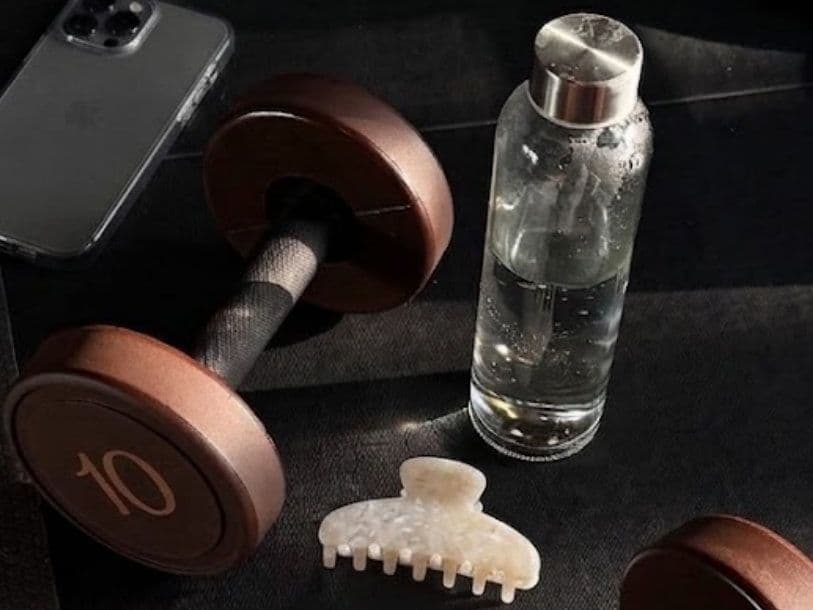
How to build a workout with only the equipment you have
Hotel gym, dumbbells at home or just a park: build a full-body session from five movement patterns, smart substitutions and simple progression. Three templates.