Apple Watch vs Oura vs Whoop for recovery-based training
Pick the one you will actually wear every night: Apple Watch if you want a screen and built-in GPS for runs and lifts, Oura Ring if you want something nearly invisible that does its best work while you sleep, and Whoop if you want a screenless band built around daily recovery and strain. You rarely need two, and if you do wear two, use one as your HRV reference, because the three calculate HRV differently and their numbers don’t line up.
SOMA Team · · 10 min read

( In short )
- Apple Watch: screen, built-in GPS and a new 0–10 Readiness score on Series 12 and Ultra 4, no subscription, but most models need charging every day.
- Oura Ring 5: the easiest to sleep in and 6–9 days of battery, but no live heart rate during workouts, Oura suggests considering taking it off for weightlifting, and the membership is needed beyond three basic scores.
- Whoop: a screenless band with 14+ days of battery and a recovery-versus-strain model, sold only as a membership from $199 a year with the hardware included.
- Don’t compare HRV across devices: Apple Health has long stored SDNN, Oura and Whoop report RMSSD, and each samples at different times of night.
- One device is enough for recovery-based training. If you wear two, pick one as your HRV reference.
How do Apple Watch, Oura and Whoop compare at a glance?
We compared the current models on the seven things that matter most if you plan training around recovery. Device facts come from each maker’s own site, checked in October 2026; accuracy claims come only from peer-reviewed studies.
| Criterion | Apple Watch (Series 12, SE 3, Ultra 4) | Oura Ring 5 | WHOOP 5.0 / WHOOP MG |
|---|---|---|---|
| Form factor | Watch with a screen, worn on the wrist | Titanium ring, 2.28 mm thick; Oura suggests considering removing it for weightlifting | Screenless sensor on a fabric band; wrist, bicep band or apparel |
| Recovery measure | Readiness score 0–10 (Series 12 and Ultra 4 only). Apple Health stores HRV as SDNN; the formula behind the new “Recovery HRV” is not stated | Readiness score 0–100. HRV measured only during sleep, reported as RMSSD | Recovery score 0–100%. HRV calculated with RMSSD during your deepest sleep |
| Sleep | Sleep score, sleep stages, sleep apnea notifications | Sleep score and sleep stages | Sleep score, sleep stages, Sleep Planner, haptic alarm |
| Workouts | Built-in GPS, live heart rate on screen, strength sessions in the Workout app | No live heart rate from the ring; heart rate shown after the session; phone GPS for pace and route | Auto-detects activities; Strength Trainer logs sets, reps and weight; phone needed for GPS |
| Battery | Up to 24 h (Series 12), 18 h (SE 3), 50 h (Ultra 4) | Up to 6–9 days, depending on ring size and use | 14+ days |
| Cost (US) | From $249 (SE 3), $399 (Series 12), $799 (Ultra 4); no subscription required | From $399 ($499 for some finishes), plus membership at $5.99/month or $69.99/year | Hardware included in the membership: $199/yr (One), $239/yr (Peak), $359/yr (Life, with WHOOP MG) |
| Screen and phone | Full screen and apps; needs iPhone 11 or later with iOS 27 | No screen; iOS and Android | No screen; iOS and Android |
How do you wear each one, including when you lift?
Apple Watch sits on your wrist with a screen you can glance at mid-set, in 40–46 mm cases or the 49 mm Ultra 4 (Apple). The trade-off: for overnight recovery data, you also sleep in a watch.
Oura Ring 5 is the smallest of the three, 2.28 mm thick and from 2 grams (Oura). It is the easiest to forget you are wearing, which matters because every recovery score depends on wearing the device to bed. The catch for lifters: Oura suggests considering removing it for weightlifting because of friction, and scratches from wear are not covered by the warranty (Oura).
Whoop is a small screenless sensor on a fabric band. For heavy grip work such as weightlifting, Whoop suggests its bicep band for a steadier heart rate signal (Whoop), which also leaves your wrist free.
How does each one measure recovery?
Apple Watch. Apple Health has long stored Apple Watch HRV as SDNN, the standard deviation of the intervals between heartbeats (Apple). Series 12 and Ultra 4 measure HRV as often as every five minutes and add a Recovery HRV that overnight vitals compare with your personal baseline (Apple; Apple). iOS 27 added an RMSSD data type to HealthKit (Apple), but the Apple pages we checked don’t say which formula Recovery HRV uses.
Apple’s new Readiness app turns recent activity, Training Load, vitals and sleep score into a 0–10 score (Recover, Pace Yourself, Ready or Go for it) once you have slept in the watch for at least seven nights. It runs only on Series 12 and Ultra 4 (Apple); SE 3 tracks HRV without it (Apple).
Oura measures HRV only during sleep, averaging five-minute samples across the night (Oura); an independent study of earlier Oura rings notes that it reports RMSSD (Dial et al., 2025). Readiness runs from 0 to 100, from Pay Attention (0–59) to Optimal (85–100) (Oura).
Whoop calculates HRV with RMSSD during your deepest sleep (Whoop) and combines it with resting heart rate, respiratory rate, sleep, skin temperature and blood oxygen into a 0–100% Recovery score, shown as green, yellow or red (Whoop).
What to do with a low reading is the same on any device: see Low HRV: should you work out today?, including why HRV often dips in the days before your period.
Why can’t you compare HRV numbers across devices?
Because they don’t measure the same thing at the same time. A widely cited review describes RMSSD as the primary time-domain measure of vagally mediated heart rate changes, while both branches of the nervous system feed into SDNN (Shaffer & Ginsberg, 2017). Timing differs too: Oura averages the whole night, Whoop focuses on your deepest sleep, and Apple samples day and night. A 38 from a ring and a 55 from a watch can both be normal for you.
Which one is most accurate?
We found no head-to-head study of the current models. In one independent study of 536 nights from 13 adults, Oura Gen 3 and Gen 4 agreed most closely with an ECG reference for overnight HRV and WHOOP 4.0 showed acceptable agreement; Apple Watch was not tested (Dial et al., 2025). A lab study of the Apple Watch Series 6 found near-perfect agreement with ECG for resting heart rate, but only moderate agreement for the normal-to-normal beat intervals HRV is calculated from (Bonneval et al., 2025). Read these as track records, not a ranking of today’s hardware.
Which one tracks sleep best for recovery?
All three give you a nightly sleep score and sleep stages. Apple adds sleep apnea notifications on current models (Apple), Oura scores sleep from 0 to 100 (Oura), and Whoop adds a Sleep Planner that estimates how much sleep you need, plus a haptic alarm (Whoop).
Research says duration is reliable and stages are estimates. In a lab study of 53 adults measured against polysomnography, earlier models of all three (Apple Watch S6, Oura Gen 2 and WHOOP 3.0) were valid for sleep timing and duration, but all needed improvement on specific stages; the lab receives research support from Whoop (Miller et al., 2022). In a study of 35 adults, Oura Gen 3 and Apple Watch Series 8 both matched polysomnography on total sleep. The watch underestimated deep sleep by about 43 minutes, while Oura’s stage estimates did not differ significantly; the lead author sits on Oura’s medical advisory board (Robbins et al., 2024).
For training decisions, that is good news: how long and how regularly you sleep matters more than your deep-sleep minutes, and all three track it.
Which one is best for tracking workouts?
Apple Watch leads on live data: built-in GPS on every current model (dual-frequency on Ultra 4), real-time heart rate, and strength sessions tracked by time, heart rate and calories (Apple). Your workout effort ratings and Training Load also feed Readiness (Apple).
Oura does not stream live heart rate during a session. It shows heart rate in the summary afterwards unless you pair a compatible chest strap, and live pace and route come from your phone’s GPS (Oura). It can auto-detect strength training (Oura), but if the ring comes off for heavy lifts, log that session by hand.
Whoop has no screen or GPS, so pace and routes need your phone. It auto-detects workouts after about 15 minutes of sustained elevated heart rate, estimates muscular load for lifting, and its Strength Trainer logs sets, reps and weight (Whoop).

If your gym changes from week to week, here is how to build a session around the equipment you have.
How long does the battery last, and why does it matter?
A recovery score needs last night’s data, so a flat battery at bedtime means no score in the morning. Series 12 lasts up to 24 hours, or 38 in Low Power Mode, with six hours of sleep tracking in Apple’s test, and 15 minutes of fast charging adds up to 12 hours (Apple), so plan a daily top-up. SE 3 lasts up to 18 hours and Ultra 4 up to 50 (Apple).
Oura Ring 5 lasts up to 6–9 days depending on ring size and use, and charges in about 80 minutes (Oura). Every Whoop membership lists 14+ days of battery (Whoop).
What does each one cost per year?
Apple Watch needs no subscription. SE 3 starts at $249, Series 12 at $399 and Ultra 4 at $799 (Apple). Because Readiness needs Series 12 or Ultra 4, the cheapest Apple Watch with a readiness score is $399.
Oura Ring 5 starts at $399, or $499 for some finishes (Oura). The membership is $5.99 a month or $69.99 a year in the US, with the first month included; without it you see only your three daily scores, battery and basic settings (Oura).
Whoop sells the hardware inside the membership: One is $199 a year and Peak $239, both with WHOOP 5.0, and Life is $359 with WHOOP MG, adding an ECG heart screener and Blood Pressure Insights (Whoop).
Over two years at list price, before tax, that works out to $399 for an Apple Watch Series 12, about $539 for an Oura Ring 5 on the annual membership (a little less with the included month), and $398 for WHOOP One.
Do you need an iPhone, and does a screen matter?
Apple Watch needs an iPhone 11 or later running iOS 27 (Apple) and is the only one of the three with a screen, so it doubles as your notification and workout display. Oura works with iOS and Android and connects to more than 100 apps (Oura). Whoop has iOS and Android apps (Whoop on Google Play) and syncs with Strava (Whoop).
All three cover cycle tracking: Apple through Cycle Tracking with wrist temperature sensing (Apple), Oura through Cycle Insights (Oura) and Whoop through Women’s Hormonal Insights on every membership (Whoop).
Which one is right for you?
- You run or ride outdoors and want live pace and heart rate: Apple Watch. Series 12 for the Readiness score, Ultra 4 for the longest battery, SE 3 if price matters more than a readiness score.
- You want something you forget you are wearing, and sleep is your main signal: Oura Ring 5. Take it off for heavy barbell days and log those sessions by hand.
- You want recovery weighed against strain, and you lift a lot: Whoop, worn on the bicep for heavy grip work, with Strength Trainer for your sets.
- You use an Android phone: Oura or Whoop. Apple Watch needs an iPhone.
- Budget comes first: Apple Watch SE 3 has no ongoing fee but no Readiness app; WHOOP One is $199 a year with the hardware included.

Should you wear two at once?
You can. A watch for workouts plus a ring for sleep works, and Whoop’s bicep band leaves your wrist free for a watch. Set a few rules first:
- Pick one HRV reference. Let one device’s recovery or readiness score make the call, judged against its own baseline.
- Set source priority in Apple Health. When two sources write the same type of data, Health uses the one at the top of the list; reorder them under Data Sources & Access (Apple).
- Know what syncs. Oura’s published Apple Health export covers sleep, heart rate and workouts but not HRV (Oura), so with a watch and a ring, the HRV in Apple Health is the watch’s.
- Count the subscriptions. An Oura ring and a Whoop band together mean two memberships.
How does SOMA fit if you already own one (or two)?
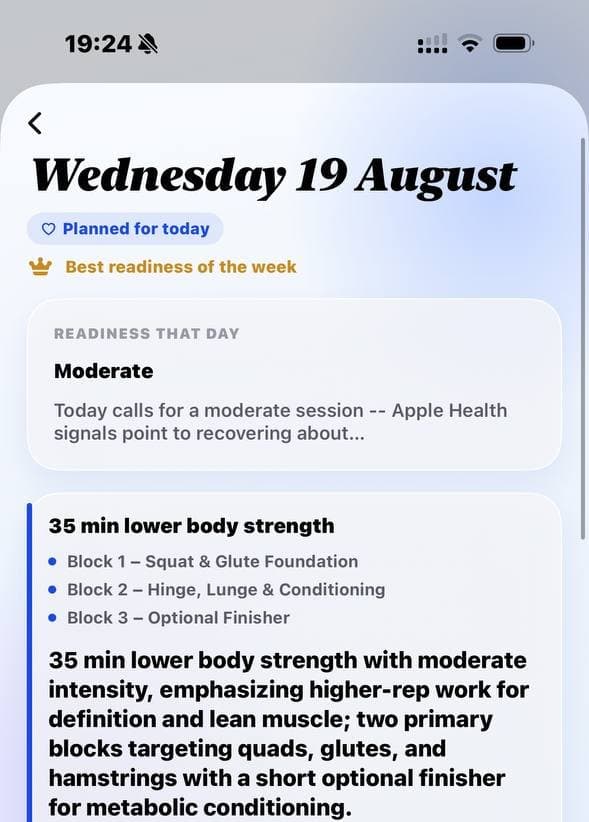
The hard part of recovery-based training is not the sensor, it is turning the numbers into a decision every morning. SOMA is an iPhone app (iOS 17 or later) with no hardware of its own. With your permission, it reads Apple Health, which carries your Apple Watch data, plus Oura and Whoop directly: sleep, HRV, resting heart rate, heart rate, steps, active energy and exercise time from Apple Health; recovery, strain and sleep from Whoop; and readiness, sleep and stress from Oura (privacy policy).
From that, SOMA makes one daily training call, Rest, Light Movement, Moderate or Push Hard, chosen by a fixed set of rules rather than AI. Two agents, a fitness coach and a nutrition expert, then build the session and the food around it, each with its reason. Because it reads all three, you can move from Oura to Whoop, or add a watch, without changing coach or losing your workout history.
For the food side, see high-protein meals from what’s in your fridge. If you are comparing coaching apps rather than hardware, start with the best AI fitness coach apps and SOMA vs Bevel. If you mostly rely on the coaching built into your device, we compare approaches on our Whoop Coach alternative and Oura Advisor alternative pages.
SOMA is general wellness software, not a medical device. It does not diagnose or treat anything, and it does not replace a clinician.
Questions people ask
Which is most accurate for HRV: Apple Watch, Oura or Whoop?
We found no study comparing the current models head to head. In one independent study of overnight HRV against an ECG reference, Oura Gen 3 and Gen 4 agreed most closely and WHOOP 4.0 showed acceptable agreement; Apple Watch was not included. Whichever you choose, consistency matters more than small accuracy differences.
Can I compare my HRV from Oura with my Apple Watch?
No. Apple Health has long stored Apple Watch HRV as SDNN, while Oura and Whoop report RMSSD, and each device measures at different times of night. Compare each device only with its own baseline.
Do Apple Watch, Oura and Whoop need a subscription?
Apple Watch does not. Oura’s membership costs $5.99 a month or $69.99 a year in the US; without it you see only three daily scores. Whoop is sold only as a membership, from $199 a year with the hardware included.
Can I wear an Oura ring and an Apple Watch together?
Yes. Pick one device as your HRV reference, and set which source Apple Health uses first under Data Sources & Access. Oura’s published Apple Health export does not include HRV, so the HRV in Apple Health will come from the watch.
Does SOMA work with Apple Watch, Oura and Whoop?
Yes. SOMA reads Apple Health, which includes your Apple Watch data, and connects to Oura and Whoop directly, then turns them into one daily plan. It runs on iPhone with iOS 17 or later; Android is on the roadmap.
Sources
- Compare Apple Watch models — Apple
- Apple Watch Series 12 — Apple
- Introducing Apple Watch Series 12, with the all-new Health Sensing System — Apple Newsroom
- Apple unveils Apple Watch Ultra 4 — Apple Newsroom
- Shop Apple Watch — Apple
- Understand your readiness score on Apple Watch — Apple Support
- heartRateVariabilitySDNN — Apple Developer Documentation (HealthKit)
- heartRateVariabilityRMSSD — Apple Developer Documentation (HealthKit)
- Manage Health data on your iPhone, iPad, or Apple Watch — Apple Support
- Oura Ring 5 — Oura
- Oura Store — Oura
- Oura Membership — Oura Member Care
- Heart Rate Variability — Oura Member Care
- Readiness Score — Oura Member Care
- Caring for Your Oura Product — Oura Member Care
- Live Activity Tracking — Oura Member Care
- Automatic Activity Detection — Oura Member Care
- Apple Health Integration — Oura Member Care
- WHOOP Membership Options — WHOOP
- Heart Rate Variability: What It Means for Fitness and Health — WHOOP
- How WHOOP Detects and Labels Your Activities — WHOOP
- WHOOP 101 — WHOOP for Developers
- WHOOP on the App Store — Apple App Store
- WHOOP on Google Play — Google Play
- An Overview of Heart Rate Variability Metrics and Norms (Shaffer & Ginsberg, 2017) — Frontiers in Public Health
- Validation of nocturnal resting heart rate and heart rate variability in consumer wearables (Dial et al., 2025) — Physiological Reports
- Validity of Heart Rate Variability Measured with Apple Watch Series 6 Compared to Laboratory Measures (Bonneval et al., 2025) — Sensors
- A Validation of Six Wearable Devices for Estimating Sleep, Heart Rate and Heart Rate Variability in Healthy Adults (Miller et al., 2022) — Sensors
- Accuracy of Three Commercial Wearable Devices for Sleep Tracking in Healthy Adults (Robbins et al., 2024) — Sensors
General wellness information, not medical advice. If something feels off — persistent fatigue, illness, pregnancy, an injury — talk to a clinician before changing how you train or eat.
Keep reading

October 1, 2026 · 9 min read
SOMA vs Bevel: 7 differences that matter
SOMA vs Bevel on 7 points: wearables, daily training calls, workouts, nutrition, AI chat, cycle awareness and price, with where each app is the stronger pick.

October 1, 2026 · 10 min read
Best AI fitness coach apps for Apple Watch, Oura and Whoop owners (2026)
Seven AI fitness coach apps for Apple Watch, Oura and Whoop owners compared on data, daily guidance, workouts, nutrition, AI chat, cycle features and price.

October 1, 2026 · 6 min read
Low HRV: should you work out today?
A low HRV reading doesn’t automatically mean rest. How to read it against your baseline, what Whoop red and low Oura readiness mean, and how to adjust today.
October 1, 2026 · 6 min read
How to build a workout with only the equipment you have
Hotel gym, dumbbells at home or just a park: build a full-body session from five movement patterns, smart substitutions and simple progression. Three templates.

October 1, 2026 · 5 min read
What to eat after a workout: high-protein meals from what’s in your fridge
How much protein to eat after training, why the 30-minute window is mostly a myth, and five high-protein meals from fridge staples, with approximate macros.