Low HRV: should you work out today?
Usually yes, just not the session you planned. A single low HRV reading is a reason to turn intensity or volume down, not to cancel by default: what matters is how far below your own baseline it sits, whether it has stayed low for several days, and how you feel. If HRV has been down for days alongside poor sleep, a raised resting heart rate or signs of illness, rest is the right call.
SOMA Team · · 6 min read

( In short )
- Judge HRV against your own rolling baseline, not against other people or a single morning.
- One low reading: keep moving, but trade intensity for easy cardio, technique or lighter volume.
- Several low days in a row, or low HRV with signs of illness: take a real rest day.
- HRV tends to dip in the second half of the menstrual cycle, so a pre-period drop can be normal.
- Apple Watch, Oura and Whoop calculate HRV differently, so don’t compare numbers across devices.
What is HRV, and why does your wearable track it?
Heart rate variability (HRV) is the small, constantly changing gap between one heartbeat and the next, measured in milliseconds. It reflects how your autonomic nervous system is balancing “rest and digest” against “fight or flight”. One common HRV measure, RMSSD, is described in a widely cited review as the primary time-domain measure of vagally mediated changes in heart rate, which is why HRV is used as a rough window into recovery (Shaffer & Ginsberg, 2017).
Two practical consequences follow. First, HRV is personal: the same review notes that it declines with age and rises with aerobic fitness, so comparing your number with a friend’s, or with a chart online, tells you very little. Second, devices don’t all calculate the same thing. Apple Health stores HRV as SDNN, the standard deviation of the intervals between heartbeats (Apple). A “45” from your Apple Watch and a “45” from a ring or band may not be the same kind of reading, so pick one device as your reference and stick with it.
Why does your baseline matter more than one reading?
Day-to-day HRV moves with sleep, stress, illness and yesterday’s training, so one low number on its own says little. That is why researchers who use HRV to guide training compare each day against a personal reference rather than a fixed target. A review of HRV monitoring in elite endurance athletes recommends appropriate averaging techniques and argues that longitudinal monitoring is needed to understand each athlete’s individual “HRV fingerprint” (Plews et al., 2013).
In one early HRV-guided training trial, the reference was simply each person’s 10-day mean minus one standard deviation: a reading below it, or a falling trend over two days, meant low-intensity training or rest that day (Kiviniemi et al., 2007).
Your wearable already does a version of this. Oura’s HRV balance compares your recent 14-day average, with the past 2–5 days weighted slightly more, against your long-term average over the past two months (Oura). Whoop calculates recovery from measurements such as resting heart rate, HRV, respiratory rate, sleep, skin temperature and blood oxygen (Whoop).
Does your menstrual cycle change HRV?
For many women, yes. A meta-analysis of 37 studies covering 1,004 naturally cycling women found that cardiac vagal activity, the parasympathetic side of HRV, tends to fall from the follicular phase to the luteal phase, with the clearest drops in the premenstrual days (Schmalenberger et al., 2019). If your HRV sags in the days before your period, that may be your normal pattern rather than a warning sign. Tracking a few cycles shows you what normal looks like for you.
What do Whoop red recovery and low Oura readiness actually mean?
Whoop scores recovery from 0 to 100% each morning. Green (67–100%) means you are “well recovered and primed to perform”; yellow (34–66%) means your body is “ready to take on moderate amounts of strain”; red (0–33%) means “rest is likely what your body needs”, with overtraining, sickness, stress and lack of sleep listed as possible reasons (Whoop).
Oura’s Readiness score also runs from 0 to 100: 85–100 is Optimal, 70–84 Good, 60–69 Fair and 0–59 Pay Attention. Oura says scores below 70 indicate that you “may benefit from prioritizing rest and recovery in the indicated areas” (Oura).
Notice the wording: “likely”, “may benefit”. Both scores are composites, and HRV is one input among several. Open the contributors before you decide. A red day driven mostly by one short night calls for a different response than a red day where HRV is down, resting heart rate is up and your temperature has crept higher.
If you mostly rely on the coaching built into those apps, we compare approaches on our Whoop Coach alternative and Oura Advisor alternative pages.
Should you work out on a low HRV day?
Usually you can, just not at full intensity. The research on HRV-guided training is encouraging but modest. In Kiviniemi’s four-week trial of 26 moderately fit men, the group whose daily intensity followed their HRV raised peak oxygen uptake from 56 to 60 ml/kg/min, while peak oxygen uptake in the fixed-plan group did not change significantly (Kiviniemi et al., 2007). A 2021 meta-analysis found HRV-guided training better at improving HRV itself, with small, non-significant advantages for fitness and performance and a lower likelihood of negative responses (Manresa-Rocamora et al., 2021). The value is less about extra gains and more about not stacking hard sessions on days your body is struggling.
So treat a low reading as a dial, not a switch:
- A little below your usual range, and you feel fine: do the planned session, warm up longer and skip the very hardest set or interval.
- Clearly below your range for a day (Whoop yellow or red, Oura Fair or Pay Attention): keep moving but turn the dial down. Choose easy cardio at a conversational pace, technique work with light loads, or the same strength session with fewer sets, stopping well short of failure.
- Low for several days, especially with poor sleep or a raised resting heart rate: take a planned easy day or a full rest day and put the time into sleep.
- Low alongside signs of illness, such as fever, sore throat or unusual fatigue: rest. Training through illness is not a test of discipline.
What can you do instead of a hard session?
A lower-intensity day is still a training day. Good options when recovery is down:
- Easy aerobic work: a walk, an easy ride or a swim at a pace where you can hold a conversation.
- Mobility and stretching: hips, upper back and hamstrings, slow and unhurried.
- Technique practice: the lifts you are learning, with an empty bar or light dumbbells.
- Half-volume strength: the same exercises with half the sets and nothing close to failure.
- Sleep: sleep feeds both Whoop recovery and Oura readiness, so an earlier night is the most direct lever you have.

Eating enough matters on easy days too. If your next question is what to eat, see high-protein meals from what’s in your fridge. If you are travelling and the hotel gym is thin, here is how to build a workout with only the equipment you have.
How does SOMA turn recovery data into one daily answer?
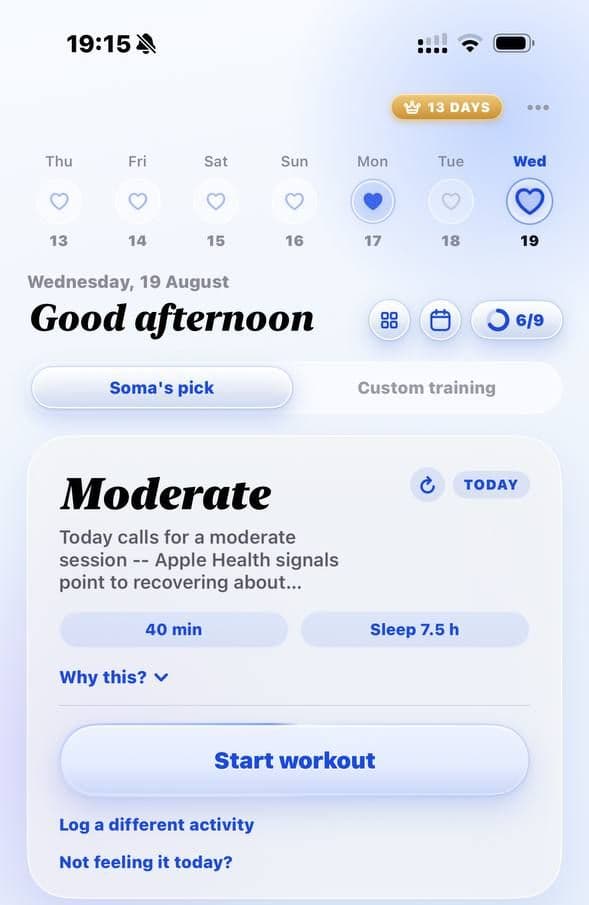
Reading three apps every morning and translating them into a decision is the part most people tire of. SOMA is an iPhone app that does the translation. Two agents, a fitness coach and a nutrition expert, read the data already on your phone from Apple Health, Apple Watch, Oura and Whoop, and return one plan for the day: the session, the food, and the reason behind each.
On a day when your data says you are still recovering, the card says so plainly, for example “Moderate today, 40 minutes” because Apple Health says you are still recovering, rather than handing you a score to interpret. The plan adapts daily to your recovery and logged meals instead of running a fixed program, and every recommendation carries its reason.
SOMA is general wellness software, not a medical device. It does not diagnose or treat anything, and it does not replace a clinician.
When should low HRV be checked by a clinician?
Questions people ask
Is it bad to work out when my HRV is low?
Not usually. One low reading is a reason to reduce intensity or volume, not an automatic rest day. Rest is the better call when HRV has been low for several days, comes with poor sleep or a raised resting heart rate, or you have symptoms of illness.
What is a normal HRV for a woman?
There is no single normal number. HRV falls with age, rises with aerobic fitness, shifts across the menstrual cycle and depends on how your device calculates it. Your own rolling average is the only comparison that means much.
Why is my HRV lower before my period?
A meta-analysis of 37 studies found that the parasympathetic side of HRV tends to drop from the follicular to the luteal phase, most clearly in the premenstrual days. A pre-period dip is often a normal pattern, and tracking a few cycles helps you recognize it.
Should I follow my Whoop or Oura score or how I feel?
Use both. If the score is low but you feel good, train with a lower ceiling. If the score is fine but you feel run-down, listen to your body. When both say you are depleted, rest.
Does SOMA replace my Whoop or Oura?
No. SOMA is software with no hardware of its own. It reads the data your Apple Watch, Oura ring or Whoop band already collects, with Apple Health as the hub, and turns it into one daily plan. It runs on iPhone with iOS 17 or later.
Sources
- An Overview of Heart Rate Variability Metrics and Norms (Shaffer & Ginsberg, 2017) — Frontiers in Public Health
- Training adaptation and heart rate variability in elite endurance athletes: opening the door to effective monitoring (Plews et al., 2013) — Sports Medicine
- Endurance training guided individually by daily heart rate variability measurements (Kiviniemi et al., 2007) — European Journal of Applied Physiology
- Heart Rate Variability-Guided Training for Enhancing Cardiac-Vagal Modulation, Aerobic Fitness, and Endurance Performance: A Methodological Systematic Review with Meta-Analysis (Manresa-Rocamora et al., 2021) — International Journal of Environmental Research and Public Health
- A Systematic Review and Meta-Analysis of Within-Person Changes in Cardiac Vagal Activity across the Menstrual Cycle (Schmalenberger et al., 2019) — Journal of Clinical Medicine
- WHOOP 101: Recovery — WHOOP for Developers
- Readiness Score — Oura Member Care
- heartRateVariabilitySDNN — Apple Developer Documentation (HealthKit)
General wellness information, not medical advice. If something feels off — persistent fatigue, illness, pregnancy, an injury — talk to a clinician before changing how you train or eat.
Keep reading

October 1, 2026 · 9 min read
SOMA vs Bevel: 7 differences that matter
SOMA vs Bevel on 7 points: wearables, daily training calls, workouts, nutrition, AI chat, cycle awareness and price, with where each app is the stronger pick.

October 1, 2026 · 10 min read
Best AI fitness coach apps for Apple Watch, Oura and Whoop owners (2026)
Seven AI fitness coach apps for Apple Watch, Oura and Whoop owners compared on data, daily guidance, workouts, nutrition, AI chat, cycle features and price.

October 1, 2026 · 10 min read
Apple Watch vs Oura vs Whoop for recovery-based training
Apple Watch, Oura Ring or Whoop for training by recovery? We compare HRV, sleep, workouts, battery, cost and phone support, and whether you need two at once.
October 1, 2026 · 6 min read
How to build a workout with only the equipment you have
Hotel gym, dumbbells at home or just a park: build a full-body session from five movement patterns, smart substitutions and simple progression. Three templates.

October 1, 2026 · 5 min read
What to eat after a workout: high-protein meals from what’s in your fridge
How much protein to eat after training, why the 30-minute window is mostly a myth, and five high-protein meals from fridge staples, with approximate macros.