How to build a workout with only the equipment you have
Build it from movement patterns, not machines: one squat, one hinge, one push, one pull and one core or carry exercise, loaded with whatever is in the room. Light dumbbells, bands and bodyweight can build muscle as long as your sets end close to failure, and when the weights can’t go up you progress with reps, sets, tempo and harder variations instead.
SOMA Team · · 6 min read
( In short )
- Five movement patterns cover the whole body: squat, hinge, push, pull, and core or carry.
- Light loads build muscle when sets end close to failure; heavy loads still win for maximal strength.
- No heavier weights? Add reps first: an eight-week trial found rep progression comparable to load progression.
- Two full-body sessions a week that work every major muscle group meet the public-health minimum.
What does a full-body workout actually need?
Not a particular machine. A balanced strength session covers a handful of movement patterns, and almost any room offers some way to load each one. Public-health guidance asks for muscle-strengthening activity on at least two days a week that works all the major muscle groups: legs, hips, back, abdomen, chest, shoulders and arms (CDC). The American College of Sports Medicine’s position stand on resistance training adds two useful ordering rules: large muscle groups before small ones, and multi-joint exercises before single-joint ones (ACSM, 2009).
Five patterns cover that list:
- Squat (front of the legs and glutes): goblet squat, split squat, step-up.
- Hinge (glutes, hamstrings, lower back): Romanian deadlift, hip thrust, glute bridge.
- Push (chest, shoulders, triceps): push-up, dumbbell press, overhead press.
- Pull (back, biceps): rows of any kind, pull-ups if there is a bar.
- Core and carry (trunk, grip): dead bug, side plank, walking with a dumbbell in one hand.
Pick one exercise per pattern, do two or three sets of each, and you have a complete session that fits in under an hour.
Can light dumbbells or bodyweight really build muscle?
Yes, with one condition: effort. A 2017 meta-analysis of 21 studies compared light loads (60% of one-rep max or less) with heavier loads, with every set taken to momentary failure. Muscle growth was similar across the loading spectrum, while gains in maximal strength were greater with heavy loads (Schoenfeld et al., 2017). So light weights build muscle when the last reps are genuinely hard, and if lifting your heaviest possible single is a goal, heavier loading still matters.
You don’t need to grind every set to absolute failure, though. A 2023 meta-analysis of 15 studies found no evidence that training to momentary failure builds more muscle than stopping short of it (Refalo et al., 2023). A practical target is to end each set when only a couple of good reps are left. With light weights, that usually means more reps than you would do with heavy ones.
Bodyweight and bands hold up too. In a five-week study of 30 university students with advanced resistance-training experience, push-ups made harder with an elastic band, done at a six-rep-max effort, produced strength gains similar to the bench press at the same effort (Calatayud et al., 2015).
How do you substitute exercises when the equipment is missing?
Match the pattern, then pick the variation that makes the last reps hard with what you have. Single-leg and slow-lowering versions make light weights feel much heavier.
- Squat: barbell squat → goblet squat with one dumbbell → rear-foot-elevated split squat (back foot on a bench, chair or sofa) → step-ups onto a bench.
- Hinge: deadlift → dumbbell Romanian deadlift → single-leg Romanian deadlift → hip thrust or glute bridge with a dumbbell on your hips.
- Horizontal push: bench press → dumbbell bench or floor press → push-up (hands on a bench to make it easier; a band across your back or feet raised to make it harder).
- Vertical push: barbell overhead press → dumbbell or band overhead press → pike push-up.
- Pull: cable row or lat pulldown → one-arm dumbbell row → band row anchored to a door or post → inverted row under a sturdy low bar or table.
- Core and carry: cable crunch → dead bug → side plank → suitcase carry with one dumbbell.
How does SOMA build the session around your equipment?
This substitution work is exactly what SOMA’s gym scan does for you. Photograph the room, whether it is a hotel gym, your living room or a friend’s garage, and the session rebuilds around the equipment that is really there instead of prescribing machines you don’t have.
The session still comes from SOMA’s daily decision. Two agents, a fitness coach and a nutrition expert, read the data already on your iPhone from Apple Health, Apple Watch, Oura and Whoop, and return one plan for the day. The plan adapts daily to your recovery, and every recommendation carries its reason.
What does a session look like in a hotel gym, at home or in a park?
Here are three templates, each about 35–45 minutes including a short warm-up. Rest one to two minutes between sets, in line with the ACSM’s guidance for muscle-building work (ACSM, 2009), and choose a load or variation that leaves only a couple of good reps in reserve at the end of each set.
Hotel gym: dumbbells, a bench and a treadmill
- Warm-up: 5 minutes of easy walking, then 10 bodyweight squats and 10 hip hinges.
- Goblet squat: 3 sets of 8–12 reps.
- Dumbbell Romanian deadlift: 3 × 8–12.
- Dumbbell bench press: 3 × 8–12.
- One-arm dumbbell row, bracing on the bench: 3 × 10–12 per side.
- Suitcase carry with the heaviest dumbbell you can hold upright: 3 × 30 seconds per side.
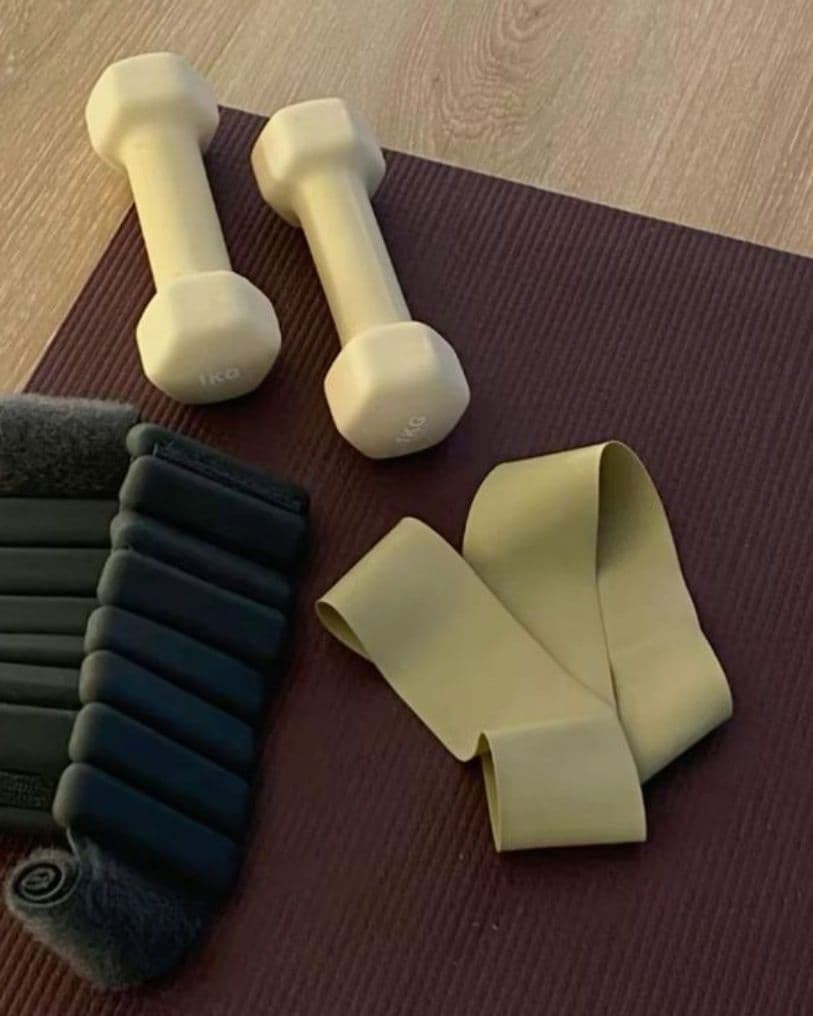
Home: one pair of light dumbbells and a band
- Rear-foot-elevated split squat with a 3-second lowering: 3 × 10–15 per leg.
- Single-leg Romanian deadlift: 3 × 10–12 per leg.
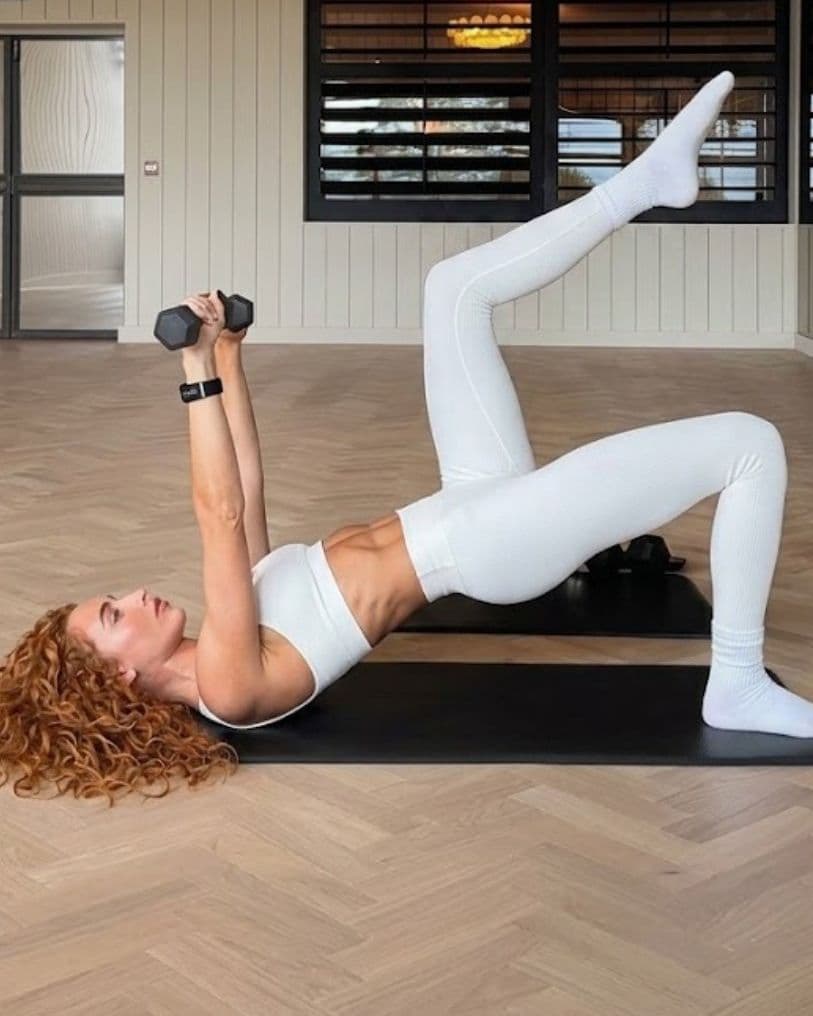
- Glute bridge with a dumbbell press: 3 × 12–15.
- Push-ups, hands raised on a sofa or step if needed: 3 sets, stopping a couple of reps short of failure.
- Band row anchored to a door: 3 × 12–20.
- Dead bug: 3 × 8 per side.
Park or bodyweight only
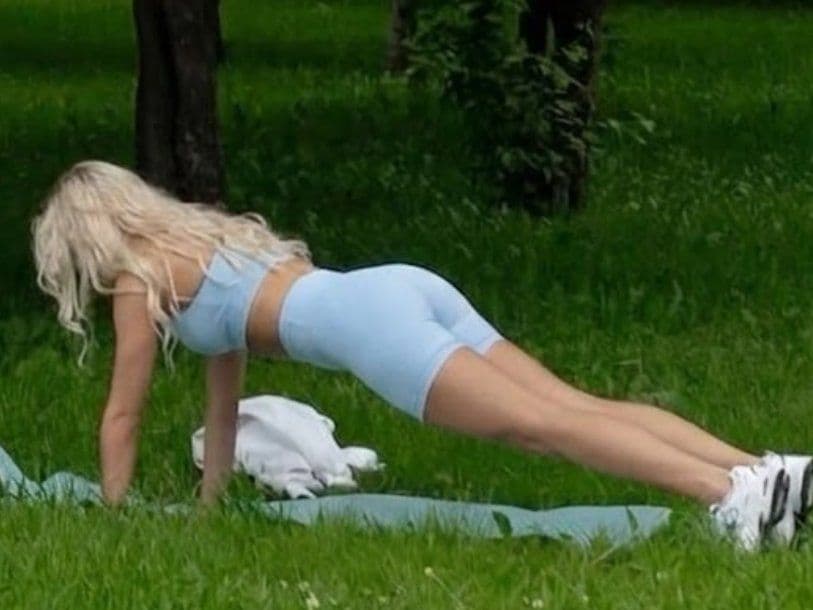
- Walking lunges: 3 × 10–12 per leg.
- Step-ups onto a park bench: 3 × 10 per leg.
- Single-leg glute bridge: 3 × 12–15 per leg.
- Push-ups, inclined on the bench or on the floor: 3 sets close to failure.
- Inverted row under a low bar, or a band row around a post: 3 × 8–12.
- Side plank: 3 × 30 seconds per side.
How do you progress when the weights don’t get heavier?
In a fully equipped gym, the classic ACSM rule is to add 2–10% to the load once you can do one or two reps more than your target (ACSM, 2009). With a fixed pair of dumbbells you need other levers, and the evidence says they work. In an eight-week trial with 43 trained participants, adding reps at a constant load produced muscle and strength changes comparable to adding load (Plotkin et al., 2022).
Progress in this order, changing one thing at a time:
- Reps: add one or two per set until you reach the top of the range.
- Sets: add a set to the first two exercises of the session.
- Tempo: slow the lowering to three or four seconds, or pause at the bottom.
- Variation: move to a harder version, such as two legs to one, or incline push-up to floor push-up to feet-raised push-up.
- Frequency: add another session in the week if recovery allows.
Write down what you did each session. Without a log, it is hard to know which lever to pull next.
How often should you train with limited equipment?
Two full-body sessions a week meets the public-health minimum (CDC), and the ACSM suggests two to three days a week for people new to strength training (ACSM, 2009). Consistency matters more than the perfect setup, and the right session on a given day depends on how recovered you are. If your HRV or readiness is down, read Low HRV: should you work out today? before you push. Afterwards, refuel with a high-protein meal from what’s in your fridge.
Questions people ask
Can I build muscle with only light dumbbells?
Yes. A meta-analysis of 21 studies found similar muscle growth with light and heavy loads when sets were taken to failure. With light weights, push sets close to failure, use single-leg and slower variations, and add reps over time. Heavy loads are still better for maximal strength.
How many exercises do I need for a full-body workout?
Five or six: one squat, one hinge, one push, one pull and one core or carry exercise, plus an optional second push or pull. Two or three sets of each covers every major muscle group.
What can replace a cable row or pull-up bar when travelling?
A one-arm dumbbell row, a resistance-band row anchored to a door or post, or an inverted row under a sturdy low bar or table. A light band is the most useful thing to pack.
How does SOMA know what equipment I have?
You photograph the room with SOMA’s gym scan, and the session rebuilds around the equipment that is really there. SOMA runs on iPhone with iOS 17 or later.
Sources
- Adult Activity: An Overview — Centers for Disease Control and Prevention
- American College of Sports Medicine position stand: Progression models in resistance training for healthy adults (2009) — Medicine & Science in Sports & Exercise
- Strength and Hypertrophy Adaptations Between Low- vs. High-Load Resistance Training: A Systematic Review and Meta-analysis (Schoenfeld et al., 2017) — Journal of Strength and Conditioning Research
- Influence of Resistance Training Proximity-to-Failure on Skeletal Muscle Hypertrophy: A Systematic Review with Meta-analysis (Refalo et al., 2023) — Sports Medicine
- Bench press and push-up at comparable levels of muscle activity results in similar strength gains (Calatayud et al., 2015) — Journal of Strength and Conditioning Research
- Progressive overload without progressing load? The effects of load or repetition progression on muscular adaptations (Plotkin et al., 2022) — PeerJ
General wellness information, not medical advice. If something feels off — persistent fatigue, illness, pregnancy, an injury — talk to a clinician before changing how you train or eat.
Keep reading
October 1, 2026 · 9 min read
SOMA vs Bevel: 7 differences that matter
SOMA vs Bevel on 7 points: wearables, daily training calls, workouts, nutrition, AI chat, cycle awareness and price, with where each app is the stronger pick.
October 1, 2026 · 10 min read
Best AI fitness coach apps for Apple Watch, Oura and Whoop owners (2026)
Seven AI fitness coach apps for Apple Watch, Oura and Whoop owners compared on data, daily guidance, workouts, nutrition, AI chat, cycle features and price.
October 1, 2026 · 10 min read
Apple Watch vs Oura vs Whoop for recovery-based training
Apple Watch, Oura Ring or Whoop for training by recovery? We compare HRV, sleep, workouts, battery, cost and phone support, and whether you need two at once.

October 1, 2026 · 6 min read
Low HRV: should you work out today?
A low HRV reading doesn’t automatically mean rest. How to read it against your baseline, what Whoop red and low Oura readiness mean, and how to adjust today.

October 1, 2026 · 5 min read
What to eat after a workout: high-protein meals from what’s in your fridge
How much protein to eat after training, why the 30-minute window is mostly a myth, and five high-protein meals from fridge staples, with approximate macros.